
How to get a 5 star food hygiene rating
In England, Wales and Northern Ireland the inspector scores three things, and the worst of the three sets your ceiling. A spotless kitchen with patchy records still can't get a 5. Your three scores are on the letter the inspector sent after the visit.
The three things an inspector scores
Each area gets its own score, in fixed steps. Lower is better: 0 means very good, 25 or 30 means urgent improvement. For a 5, every area has to be at 0 or 5.
Food handling
How food is stored, prepared, cooked, cooled and reheated. Temperatures, cross-contamination, handwashing.
Building and cleaning
Cleanliness, repair, layout, lighting, ventilation, pest control and handwashing facilities.
Food safety management
A written system such as SFBB or HACCP, records that are actually filled in, staff training and your track record. It has no 15 or 25: it jumps from 10 to 20.
Why so many kitchens stop at a 3 or 4
The rating isn't just the total. Each rating also has a ceiling on the worst single area, so one weak area caps you however good the rest is.
Food safety management is where this bites hardest
The inspector scores it by whether you have a written system.
A system in place
A 5 is within reach.
A system in progress
The best you can get is a 4.
No system
A 20 holds the whole rating at 1, even with a perfect kitchen.
It is also the area you can fix fastest, because it is mostly paperwork that has to exist and be kept up every day.
4 or 5: is a 4 good?
Yes. A 4 means the inspector found hygiene standards were good. It is one step below the top rating, and the gap is smaller than it looks.
Good
- Total of the three scores
- 20 or less
- Worst single area
- 10
Very good
- Total of the three scores
- 15 or less
- Worst single area
- 5 or better
The difference is one area. With every area at 0 or 5 you get a 5. One area at 10 makes it a 4, even when the total is 15, the same total as a 5. Try 0, 5 and 10 in the calculator.
What turns a 5 into a 10
The Food Standards Agency's scoring guide describes each score. Side by side, the step is small.
If you're on a 4
Find the area scored 10 on your inspection letter. The letter also lists what the inspector wants changed.
Once these are fixed and your records show it, you can ask for a re-rating. A 4 qualifies: the re-visit scheme covers every rating from 0 to 4. What it costs and how to ask.
- An SFBB or HACCP pack that no longer matches how the kitchen works, for example after a menu change.
- Records with gaps, or pages that look filled in all at once.
- Points from the last inspection letter that are still not done.
- New starters who haven't been shown your system.
- Only one person who can explain the system. If they're off on the day, nobody else can answer the inspector.
What to do before your next inspection
In the order that usually moves the score most.
- Get your written system in place and in useSafer Food, Better Business or your own HACCP plan, filled in for your kitchen, not a blank pack on a shelf.
- Keep the daily records every dayFridge and freezer temperatures, cooking and cooling checks, opening and closing checks, cleaning sign-offs. Inspectors look for gaps and for weeks filled in with one pen.
- Make allergens answerableEvery dish with its 14 allergens, kept up to date when a recipe changes, so any member of staff can answer a customer.
- Show your team is trainedFood hygiene certificates and a record of who was shown what, including new starters.
- Fix the building items on your last letterRepairs, handwash basins, pest proofing. Keep invoices and photos: you will need them if you ask for a re-rating.
The temperatures an inspector checks
Temperature control is part of the food handling score. These are the figures in the government's food hygiene guidance for businesses.
Hot food
Cooking: in the centre for 2 minutes.
Also safe for cooking: 30 seconds at 75°C, or 6 seconds at 80°C.
Hot holding: 63°C or above. Hot food on display below 63°C: up to 2 hours, then cool it to 8°C or below, or throw it away.
Reheating: steaming hot all the way through, and only once.
Cold food
Chilled food: 8°C or below, a legal requirement in England, Wales and Northern Ireland.
Fridges: set to 5°C or below so food stays cold enough.
Chilled food out on display: up to 4 hours, then throw it away.
A quick self-check
Tick what is true in your kitchen today. Nothing you tick leaves this page.
Prefer paper for now?
Get our free HACCP record pack: daily logs, cleaning schedule and delivery checks, ready to print.
Re-rating: what the visit costs and how to ask
You don't have to wait for the next routine inspection. Once you've fixed what the inspector found, you can ask your council to come back and rate you again.
England
Each council decides whether to charge and how much. This is what the ones we checked charge.
Wales
Every council charges.
Northern Ireland
Every council charges.
How soon the visit happens
| Where | When |
|---|---|
| Where the council charges | Within three months of your request, or of your payment if it wants the fee first. |
| England, no charge | Usually not in the first three months after the inspection, and you shouldn't wait more than six months from asking. |
| Wales and Northern Ireland | Within three months of your written request. |
How to ask
- 1
Accept the rating. If you think it was wrong on the day, appeal in writing within 21 days instead.
- 2
Fix every point on the inspector's letter, in all three areas. Keep photos, invoices and certificates as you go.
- 3
Write to the council. Email is fine. Say what you changed and attach the evidence, including your records since the inspection. A council can turn down a request without enough evidence.
- 4
Pay the fee if your council charges one.
- 5
The inspector comes back unannounced and looks at everything, not just what you fixed. The rating can go up, down or stay the same.
If your fixes are mostly records and management, a council that charges may time the visit towards the end of the three months, to see that the change has lasted. Keep the daily records going from the day you ask.
Re-rating fees council by council, appeal or re-rating, and a request letter you can copy.
How Blueroll helps

Daily records on the team's phones
Opening and closing checks, fridge and freezer temperatures and sign-offs are done on the phone, on the day. Each one is saved with the time and who did it.
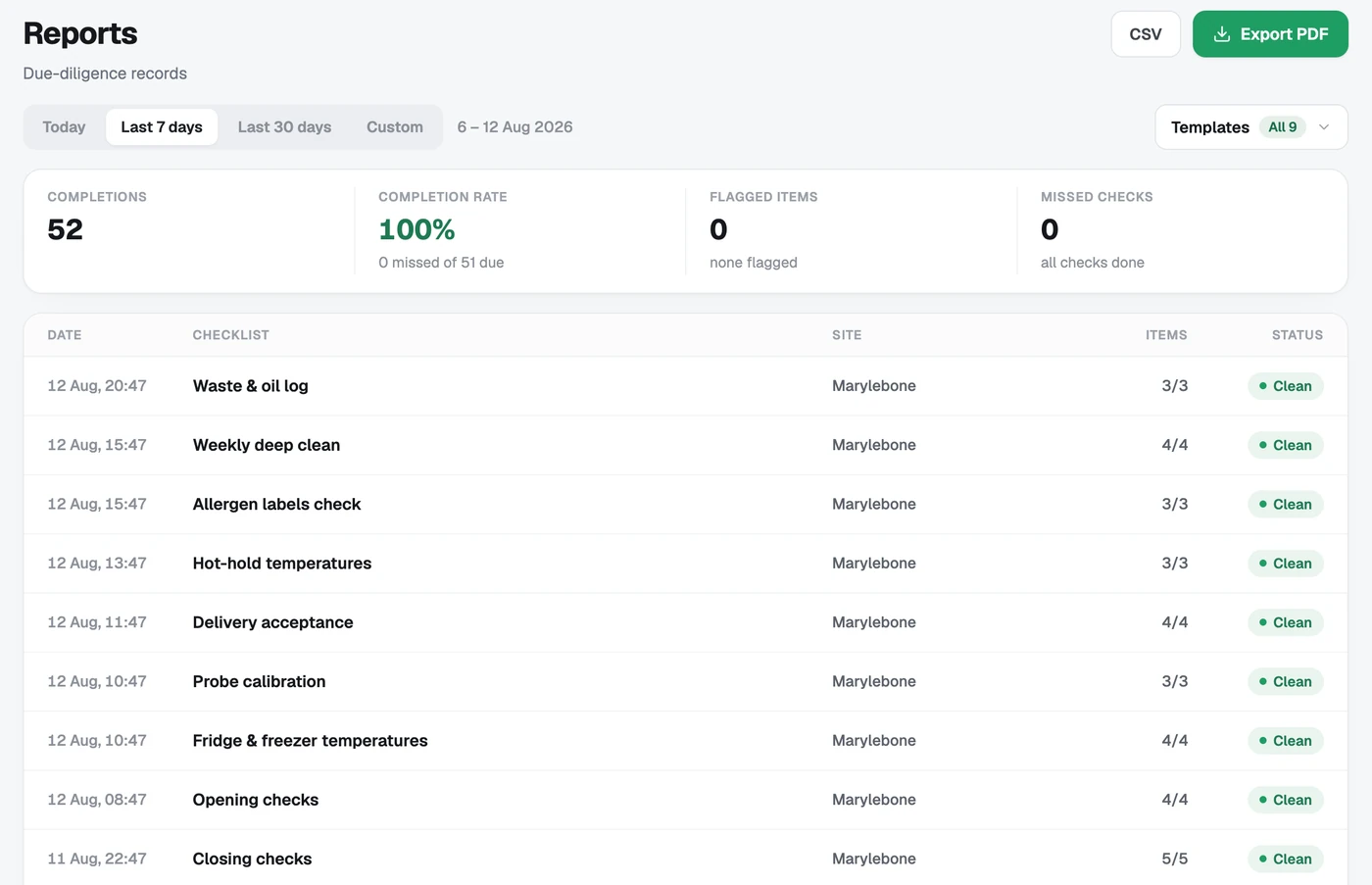
Records ready when the inspector asks
Every completed check lands in one log you can filter by date. Export it as a PDF for the inspector, or to send with a re-rating request.
Questions owners ask
What do you need for a 5 food hygiene rating?
All three area scores at 0 or 5, adding up to 15 or less. One weak area caps the rating however good the others are.
Is a food hygiene rating of 4 good?
Yes. A 4 means hygiene standards are good, one step below the top rating. What stops it being a 5 is at least one area scored 10 instead of 5, and once that's fixed you can ask for a re-rating visit.
What's the difference between a 4 and a 5 food hygiene rating?
For a 5, all three area scores must be 0 or 5, which keeps the total at 15 or less. A 4 allows areas at 10 and a total of up to 20. So scores of 0, 5 and 10 add up to 15 but still give a 4.
What is confidence in management?
The inspector's view of how well you manage food safety: a written system such as SFBB or HACCP, records that are kept, staff training and your track record. With no written system this area scores 20 or 30, which on its own holds the rating at 1 or 0.
Can I get my food hygiene rating changed before the next inspection?
Yes. Accept the rating, fix everything on the inspector's letter, then ask your council in writing for a re-rating visit. The visit is unannounced and the rating can go up, down or stay the same. Full guide.
How much does a food hygiene re-rating visit cost?
In England each council decides whether to charge and how much. The ones we checked charge £120 to £371. In Wales every council charges, about £255, and in Northern Ireland it's £150. Fees council by council.
What temperature should a fridge be for a food hygiene inspection?
Chilled food must be kept at 8°C or below in England, Wales and Northern Ireland. Guidance is to set fridges to 5°C or below so food stays cold enough when the temperature changes. Write the readings down so the inspector can see them.
Do I have to display my food hygiene rating?
In Wales and Northern Ireland, yes, at each customer entrance. In England it's voluntary, but your rating is published online either way.
We'll set up your daily records for you, free
Send us photos of the sheets you use now. We turn them into checklists your team ticks off on a phone, with the time and name saved for the inspector. Ready within one working day. 14 days free, then £24.99 a month per site.
Sources
- GOV.UK, Food Hygiene Rating Scheme guidance for businesses
- Food Standards Agency, Food Hygiene Rating Scheme brand standard (score descriptions, Tables 2 to 4, Section 8 on re-visits)
- GOV.UK, chilling and freezing, cooking, cleaning and cross-contamination
- Re-rating fees: Ipswich and Windsor and Maidenhead (England), Pembrokeshire (Wales), Antrim and Newtownabbey (Northern Ireland)
- Blackpool Council, how food hygiene ratings are worked out
- Reigate and Banstead Council, FHRS information for businesses
- Calderdale Council, food hygiene ratings guide (management scores)