Blueroll Blueroll Start for free
Who it's for
Independents Groups & estates NEW Franchises
Features
Multisite NEW HACCP Checklists Allergen Matrix AI Recipe Import Compliance Reports Team Management Deliveries Documents HACCP Pack Incidents
Free tools
Free HACCP template Free self-audit Check a hygiene rating Hygiene rating maps See all free tools →
Pricing FAQ Sign in
Start for free
Blueroll › Free Tools › Restaurant cleaning checklist

Free restaurant cleaning checklist

A printable daily cleaning checklist for the kitchen, front of house and restrooms, plus a filled-in example and a weekly, monthly and sanitizer log, built on the FDA Food Code.

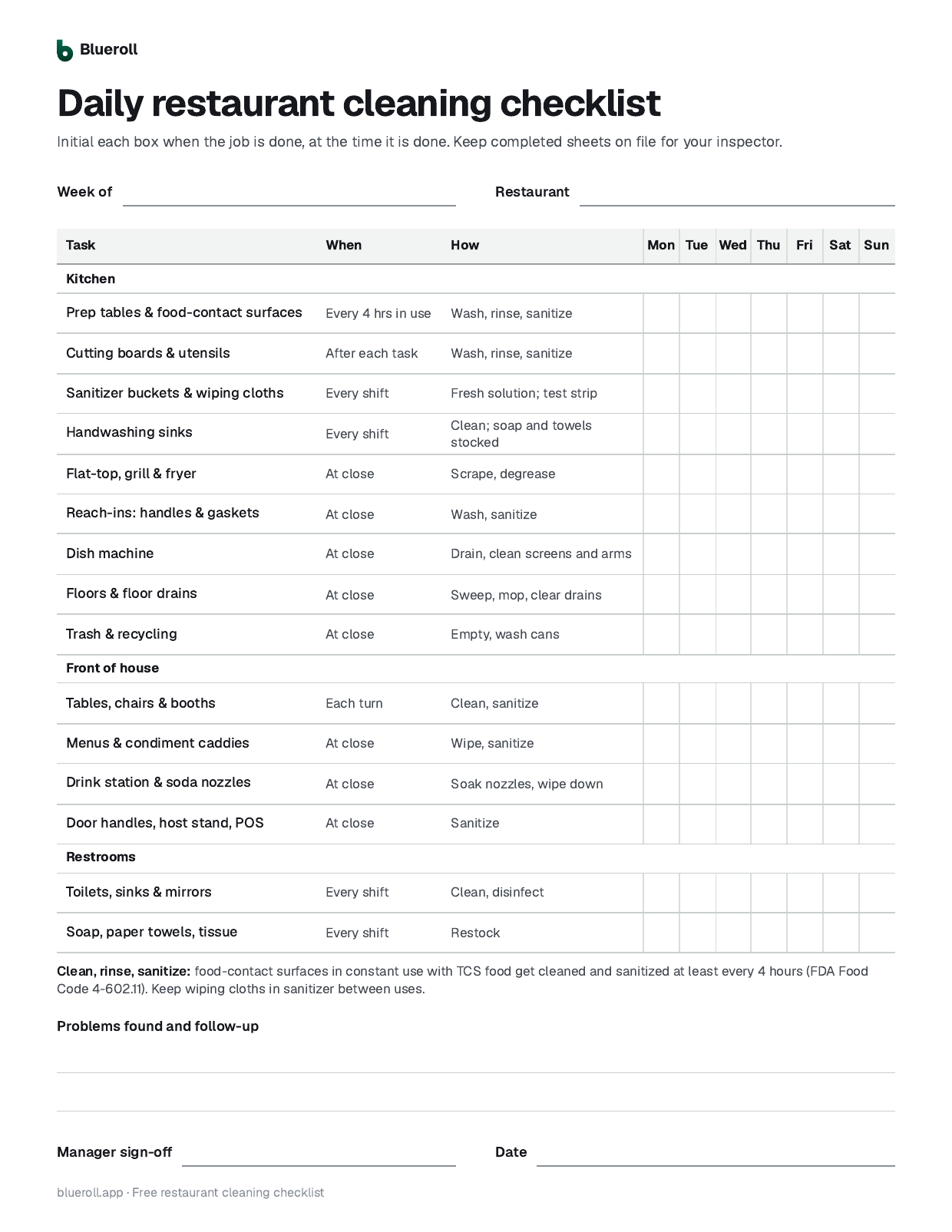
Blank daily restaurant cleaning checklist: kitchen, front-of-house and restroom tasks with when and how, and a column for each day

How to use the checklist

  1. Post the daily checklist by the dish pit.
  2. Cross off tasks you don’t have and add your own equipment.
  3. Initial each task when it’s done, at the time it’s done.
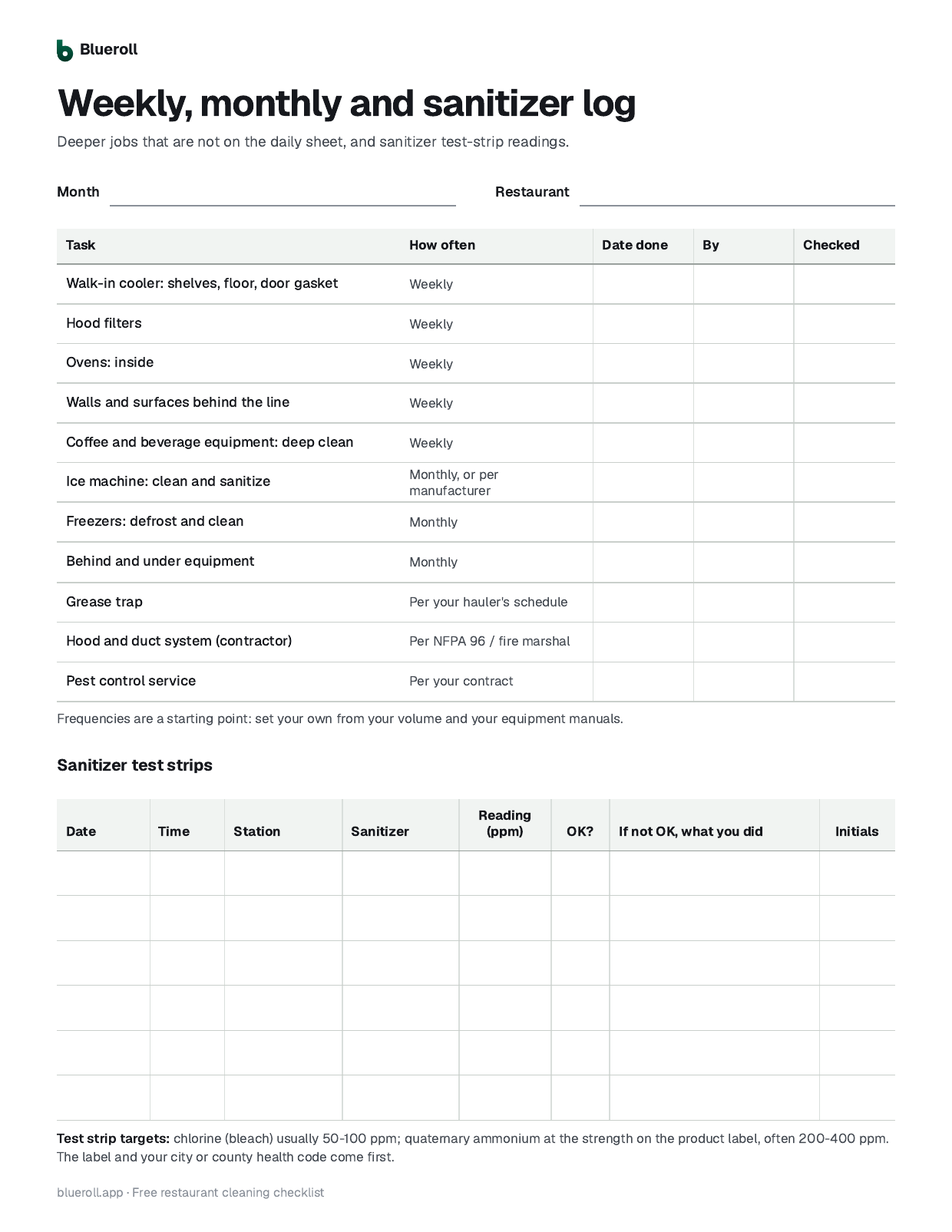
  4. Test every new sanitizer bucket and write the reading on the sanitizer log.
  5. Have a manager check the sheets and keep them on file for your inspector.

The food temperature log and the restaurant health inspection checklist are free too.

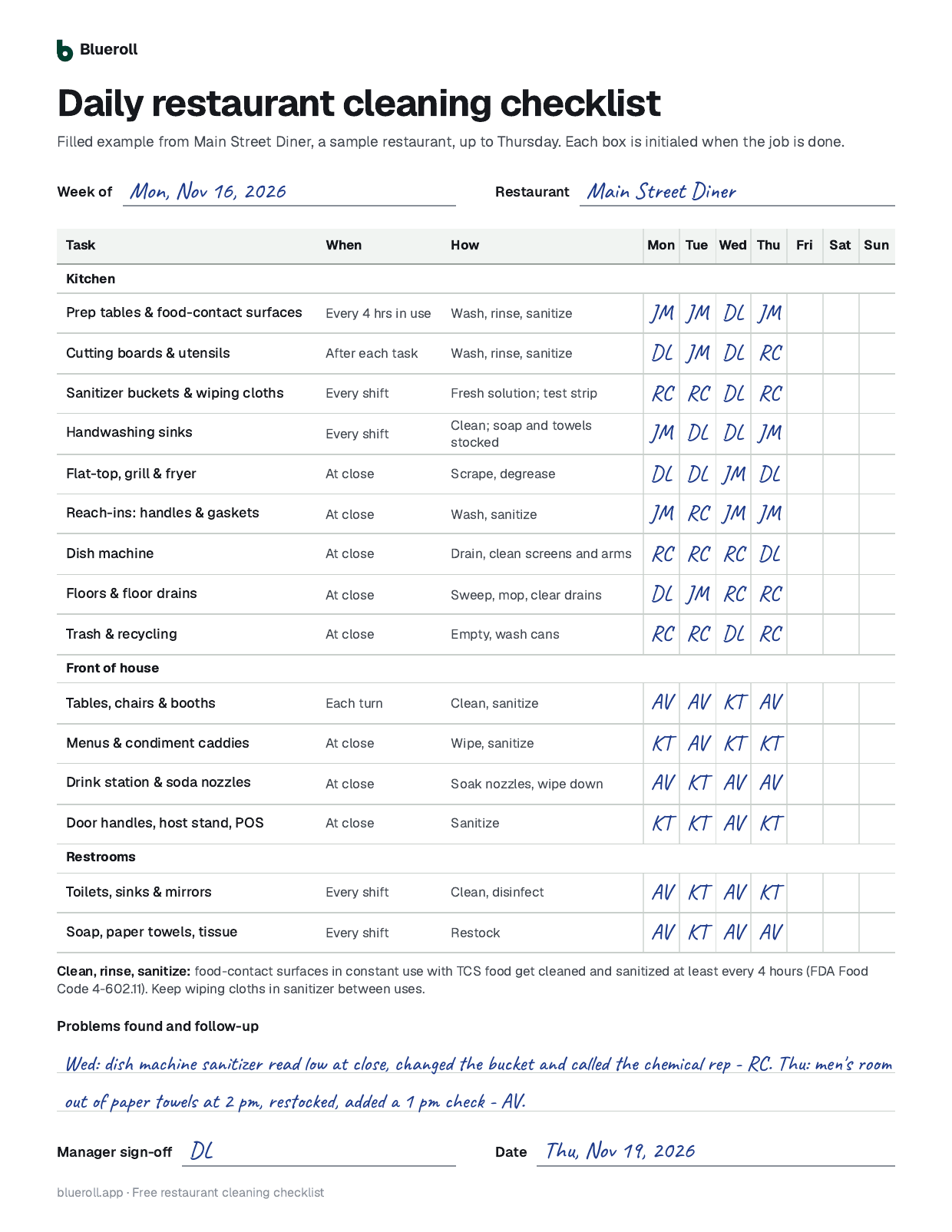
Filled-in daily restaurant cleaning checklist, with initials against each task

How often each task comes round

The checklist already lists these tasks. Move them to suit your volume and your equipment.

Every shift and daily

  • Prep tables and food-contact surfaces
  • Cutting boards and utensils
  • Sanitizer buckets
  • Handwashing sinks
  • Flat-top, grill and fryer
  • Reach-in handles and gaskets
  • Dish machine
  • Floors, drains and trash
  • Dining room, drink station and restrooms

Weekly

  • Walk-in shelves, floor and door gasket
  • Hood filters
  • Oven interiors
  • Walls behind the line
  • Coffee equipment

Monthly or less often

  • Ice machine
  • Freezers
  • Behind and under equipment
  • Grease trap, on your hauler’s schedule
  • Hood and ducts, on the NFPA 96 schedule for your cooking volume

What the Food Code expects

Inspectors check that food-contact surfaces are clean and sanitized, that sanitizer is at the right strength, and that handwashing sinks are stocked and used only for handwashing. Most state and local codes are based on the FDA Food Code, and your local code is the one that applies.

Clean, rinse, sanitize

  1. Scrape off food and debris.
  2. Wash with detergent and warm water.
  3. Rinse with clean water.
  4. Sanitize at the right strength for the contact time on the label.
  5. Let it air-dry.

Surfaces in constant use with TCS food need this at least every 4 hours (Food Code 4-602.11).

Blank weekly and monthly cleaning log with a sanitizer test-strip log

What costs points at an inspection

In cities with letter grades and scores, these show up as violations that lower your grade. How inspections are scored in New York City, Los Angeles, San Francisco, Chicago and Seattle.

Sanitizer at the wrong strength

Test every bucket with the matching strips and write the reading down.

Wiping cloths left out

Keep them in sanitizer between uses, not on the counter.

A blocked handwashing sink

Stocked with soap and towels, and used only for handwashing.

No record of cleaning

Initials on every task show it happens every day, not only on inspection day.

How Blueroll does it

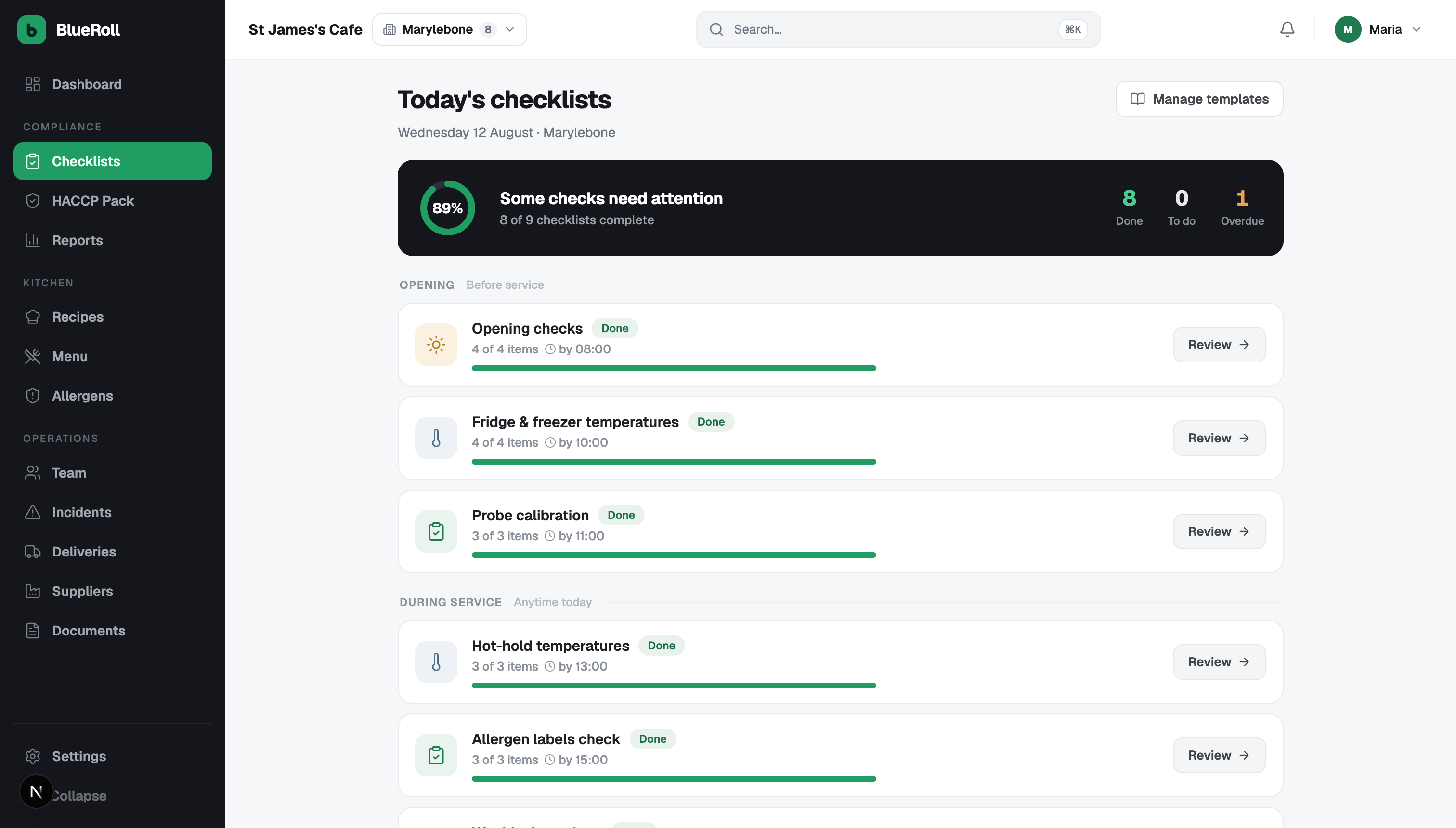
Blueroll puts the same checklist on your team’s phones. Every task is ticked with a name and a time, a manager signs off the finished list, and the record is ready to show your health inspector. See how the checklists work.

Try it free for 14 days, no card needed. Start the free trial.

Today’s checklists in Blueroll: opening checks, fridge and freezer temperatures, probe calibration and hot-hold temperatures, each marked done

Frequently asked questions

How often should a restaurant be cleaned?

Food-contact surfaces after each task and at least every 4 hours while in use; the line, floors, restrooms and dining room every day; walk-ins, hood filters and ovens every week; freezers, ice machines and behind equipment every month. Hoods and ducts follow the NFPA 96 schedule for your cooking volume.

What sanitizer concentration should I use?

Follow the product label and your local health code. As a guide, chlorine bleach solutions are usually 50 to 100 ppm and quaternary ammonium (quat) solutions often 200 to 400 ppm. Test every new bucket with the matching strips and write the reading on the sanitizer log.

Is this checklist free?

Yes. No charge, no account and no watermark. Enter your email, the PDF downloads, and you can print as many copies as you need.

Get the free cleaning checklist

Sources